Alaska Airlines Flight 1282 Plug Door Failure and the Structural Integrity of Transport Aircraft
Updated: Apr 14, 2026
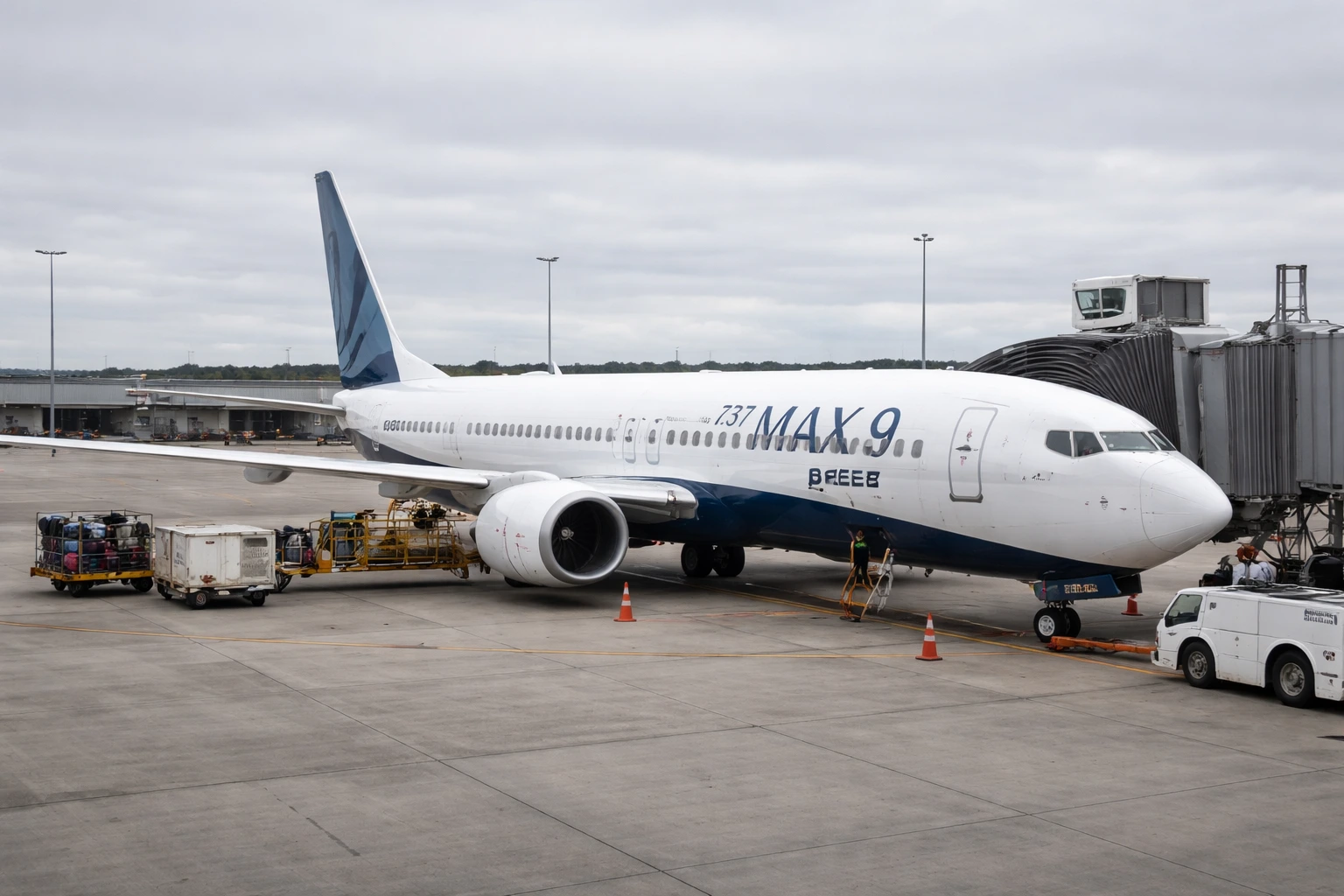
A Boeing 737-9 MAX operating as Alaska Airlines Flight 1282 departed Portland, Oregon, on January 5, 2024, before a mid-cabin plug-door panel separated in climb. The in-flight panel loss caused rapid decompression and forced the crew to declare an emergency and return to Portland International Airport. Federal investigators are examining the structural failure with particular focus on the plug-door retention system, its installation, and the production controls tied to that assembly.
Accident Summary
| Date | January 5, 2024 |
|---|---|
| Location | Near Portland, Oregon, United States |
| Aircraft | Boeing 737-9 MAX |
| Operation | Part 121 scheduled passenger service; Portland, OR to Ontario, CA |
| Occupants | 180 total (174 passengers; 6 crew) |
| Fatalities | 0 |
| Phase of Flight | Climb |
| Investigation | National Transportation Safety Board (NTSB) with Federal Aviation Administration participation |
What Happened
On January 5, 2024, Alaska Airlines Flight 1282, a Boeing 737-9 MAX flying a scheduled route from Portland, Oregon, to Ontario, California, suffered a major fuselage opening shortly after takeoff. While climbing through about 16,000 feet, the aircraft lost a mid-cabin plug-door panel, leaving a large breach in the cabin sidewall and triggering rapid depressurization.
The crew declared an emergency and returned safely to Portland. No one was killed, and no passenger was seated directly beside the opening, though several occupants reported minor injuries. One passenger reportedly had his shirt torn away by the force of the decompression.
The separated plug panel was later found in a residential area in suburban Portland. That recovery may help investigators reconstruct how the panel came free in flight and whether the attachment hardware remained consistent with the intended installation.
FAA Response and Fleet Grounding
After the event, the Federal Aviation Administration issued an emergency directive grounding certain Boeing 737-9 MAX aircraft equipped with the same mid-cabin plug-door arrangement. The order affected roughly 171 airplanes worldwide while operators and regulators inspected the plug assemblies and adjacent fuselage structure.
Those inspections centered on the retention hardware, the way the plug was installed, and the manufacturing and quality-control steps used during assembly. A key question is whether the issue was limited to one airplane or reflected a broader production problem.
The Plug Door Configuration
The Boeing 737-9 MAX can be built with an optional mid-cabin emergency exit when seat capacity requires it. In lower-density cabin layouts, that opening may instead be closed with a fuselage plug panel installed where the exit door would otherwise sit.
The plug panel forms part of the airplane’s external skin and pressure boundary. Because cabin pressure rises above ambient pressure in flight, the integrity of that structure is critical to keeping the fuselage closed under load. Investigators will likely examine whether the configuration created any vulnerability in fit, retention, or inspection access.
If a component that helps seal the pressure vessel fails, the result can be rapid decompression and heavy aerodynamic loading on nearby structure. That places immediate focus on both design intent and assembly execution.
Historical Context: United Airlines Flight 811
The Alaska Airlines event did not cause fatalities, but aviation history includes door-related structural failures with much worse outcomes. That comparison helps show how quickly a pressurized-fuselage breach can escalate.
On February 24, 1989, United Airlines Flight 811, a Boeing 747 flying from Honolulu to Auckland, suffered a cargo-door failure while climbing through about 23,000 feet. The door opened in flight, a large section of fuselage failed, and nine passengers were ejected and killed. The event remains one of the clearest examples of how door-system failures can become catastrophic.
That accident led to extensive scrutiny of cargo-door latching and the structural design of fuselage door systems. The resulting changes were aimed at preventing recurrence through both design improvements and regulatory action.
Flight 811 remains relevant here because it underscores the safety importance of door retention and pressure-boundary integrity on transport-category aircraft.
Structural Integrity and Pressurization Loads
Transport-category airplanes operate as pressurized structures. In flight, the fuselage must contain the pressure difference between the cabin and the thinner outside air at altitude. That means even a localized structural failure can produce system-wide consequences.
When part of the pressure vessel separates, decompression can load nearby structure, disturb cabin furnishings, and expose passengers and crew to intense airflow forces. Even where the event remains survivable, the structural implications are serious.
For that reason, door systems, plug assemblies, and surrounding fuselage structure are subject to strict certification requirements and tight manufacturing tolerances. A key investigative issue will be whether the airplane conformed to that standard when it left production and entered service.
Relationship to Prior Boeing 737 MAX Events
The Flight 1282 event occurred after years of close scrutiny of the 737 MAX program. In 2018 and 2019, crashes involving Lion Air Flight 610 and Ethiopian Airlines Flight 302 led to a worldwide grounding while changes were made to the aircraft’s flight-control systems.
Those earlier accidents focused on flight-control logic, training, and certification. The Alaska Airlines event instead shifted attention to structural integrity, production quality, and whether installation and inspection processes were adequate for a critical fuselage closure.
Investigation
The National Transportation Safety Board opened an investigation into the Flight 1282 decompression event. Investigators are reviewing structural components, production records, installation work, maintenance history, and recorded flight data, along with cockpit voice information. A central issue is how a plug-door panel that should have remained secured through normal pressurized flight separated during climb.
Investigators will likely focus on the sequence that allowed the plug to move out of position and depart the aircraft, and on whether design, manufacturing, installation, inspection, or maintenance factors played a role. For related analysis of similar door-separation events involving Boeing aircraft in flight, see this commentary.
The findings could lead to further directives, engineering changes, inspection revisions, or production-control measures. Structural investigations of this kind often have effects well beyond the single airplane involved.
Aviation Accident Litigation
Structural-failure events involving transport aircraft often lead to both technical investigation and civil litigation. Those cases may examine aircraft design, certification history, manufacturing steps, maintenance practices, and operational decision-making. The legal review is often as document-intensive as the engineering review.
For broader context on major airline incidents and the work of aviation accident lawyers, this event also connects to recurring issues involving aircraft design, certification, and federal preemption in aviation product liability.
Consultation Regarding Aviation Accident Investigations
Families, referring attorneys, and journalists sometimes seek legal consultation or technical insight regarding aviation accidents and investigative issues discussed in these analyses. Inquiries may be directed to Katzman, Lampert & Stoll at the link below.
Aviation Accident Litigation
- Aviation Accident Litigation
- Commercial Airline Accident Litigation
- Private and Corporate Aircraft Accident Litigation
- Military & Government Contractor Aviation Litigation
- Complex Aviation Litigation Methodology
- NTSB Investigations & Civil Aviation Claims
- Federal Preemption in Aviation Product Liability
- Defeating GARA Defenses in Aviation Product Liability Litigation
- For Families and Survivors
MICHIGAN OFFICE
Katzman Lampert & Stoll
950 West University Dr #101
Rochester, MI 48307
E-mail: Click to use our Contact Form
Toll-Free: (866) 309-6097
Phone: (248) 258-4800
Fax: (248) 258-2825
COLORADO OFFICE
Katzman Lampert & Stoll
9596 Metro Airport Ave.
Broomfield, CO 80021
E-mail: Click to use our Contact Form
Toll-Free: (866) 309-6097
Phone: (303) 465-3663
Fax: (303) 867-1565
PENNSYLVANIA OFFICE
Katzman Lampert & Stoll
121 N. Wayne Ave. # 205
Wayne, PA 19087
E-mail: Click to use our Contact Form
Toll-Free: (866) 309-6097
Phone: (610) 686-9686
Fax: (610) 686-9687