

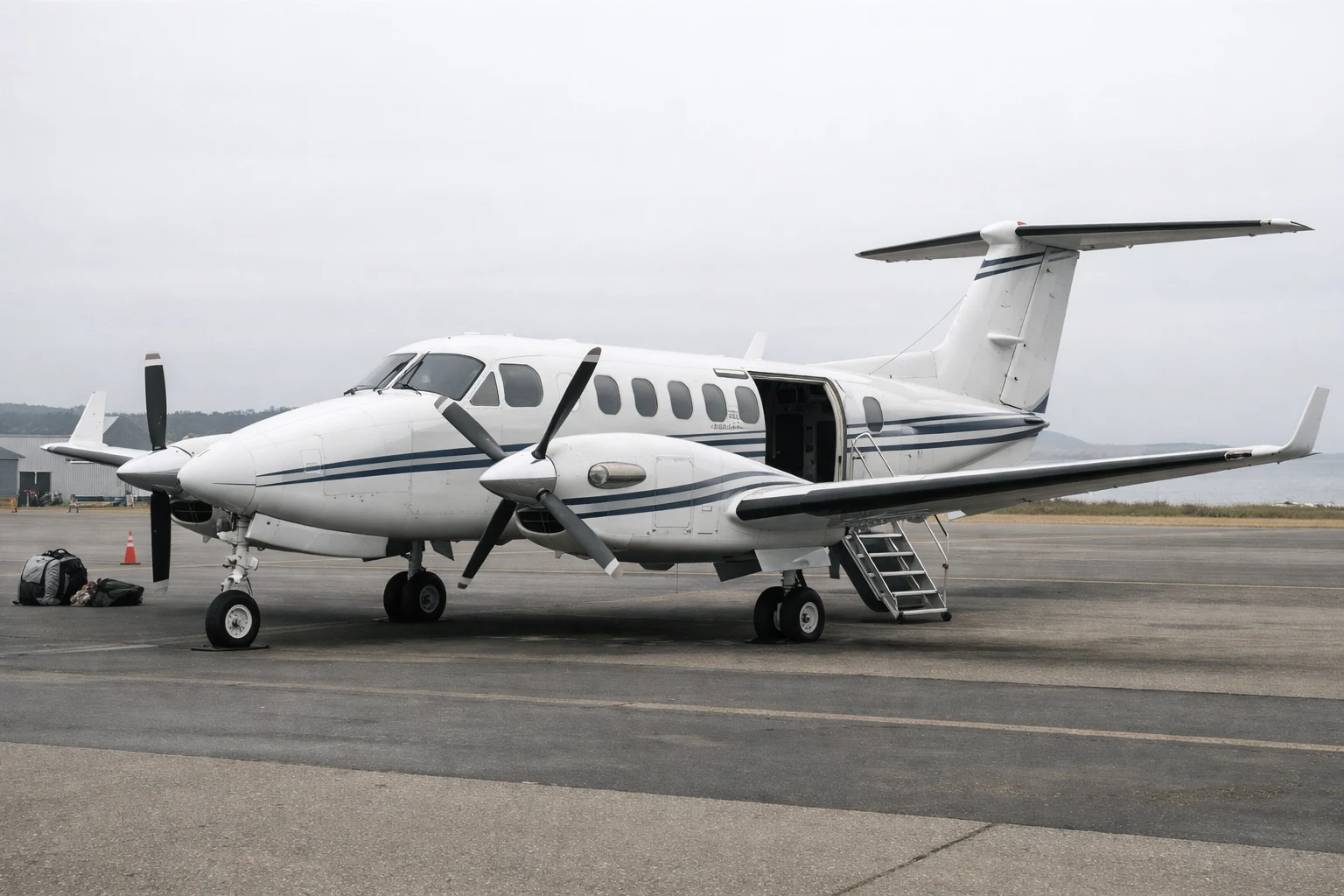
Beechcraft King Air 350 Skydiving Crash at Dillingham Airfield, Oahu
Updated: Mar 31, 2026
On June 21, 2019, a Beech King Air 65-A90 operating as a skydiving aircraft crashed shortly after takeoff from Dillingham Airfield on the island of Oahu, Hawaii. All eleven persons aboard the aircraft — the pilot and ten passengers — were fatally injured in the accident.
Accident Summary
| Date | June 21, 2019 |
| Location | Dillingham Airfield, Oahu, Hawaii, USA |
| Aircraft | Beech King Air 65-A90, N256TA |
| Operation | Part 91 parachute jump flight |
| Occupants | 10 passengers, 1 pilot |
| Fatalities | 11 |
| Phase of Flight | Shortly after takeoff |
| Investigation | National Transportation Safety Board (NTSB) |
The aircraft departed from Dillingham Airfield on a local skydiving flight and crashed moments after liftoff. Witness accounts and investigative findings indicated that the airplane rolled left, became inverted, and descended into terrain at low altitude, followed by a post-impact fire.
The National Transportation Safety Board conducted a full investigation and later issued a final report identifying both the immediate cause of the loss of control and several contributing operational, maintenance, and regulatory factors.
Aircraft and Operational Context
The aircraft involved in the accident was a Beech King Air 65-A90, a twin-engine turboprop that had been used in parachute-jump operations. Aircraft used for skydiving flights often conduct repeated takeoffs, climbs, descents, and rapid turnarounds during the course of a day, creating operational conditions that require close attention to loading, aircraft condition, and handling characteristics.
Parachute-jump operations can present distinct performance and safety considerations. Aircraft loading may vary from flight to flight, center-of-gravity placement can become especially important, and pilots may operate in recurring high-workload departure profiles. These considerations can become critical during takeoff, where limited altitude leaves little margin for recovery from aerodynamic upset or loss of control.
Accident Investigation
The National Transportation Safety Board dispatched investigators to examine the wreckage, review maintenance and operational records, evaluate pilot training and qualifications, and analyze the aircraft’s performance during takeoff. In accidents of this type, investigators assess aircraft systems, structural condition, loading, pilot handling, and the operator’s maintenance and training practices.
The NTSB’s final report concluded that the probable cause of the accident was the pilot’s aggressive takeoff maneuver, which resulted in an accelerated stall and subsequent loss of control at an altitude too low for recovery. The Board also identified contributing factors, including operation of the airplane near its aft center-of-gravity limit, the pilot’s lack of adequate training and experience in that flight regime, the failure to detect and repair a twisted left wing that reduced stall margin, and shortcomings in the regulatory framework governing parachute-jump operations.
Determining the cause of an aviation accident requires detailed examination of aircraft systems, engines, flight controls, airworthiness history, operational procedures, and available evidence concerning aircraft performance. The investigative process conducted by the National Transportation Safety Board is discussed in greater detail in our overview of the NTSB investigation process.
Operational and Regulatory Issues
The NTSB’s final report placed significant emphasis on the operational and regulatory environment surrounding parachute-jump flights. In addition to pilot handling and loading considerations, the investigation examined maintenance practices, airworthiness oversight, and the adequacy of existing regulatory controls applicable to this type of operation.
Operational oversight and regulatory compliance are frequently central issues in aviation accident investigations. In this case, the final report highlighted concerns involving training quality, aircraft maintenance, operator oversight, and the broader regulatory framework for parachute-jump operations. These issues illustrate how accident causation may extend beyond the final seconds of flight and implicate longer-term operational and maintenance failures.
Aviation Accident Litigation
Complex aviation accidents frequently involve multiple technical and regulatory issues, including aircraft maintenance practices, pilot training, operational decision-making, airworthiness compliance, and federal oversight responsibilities. These issues are often examined in subsequent aviation wrongful death claims.
Examples of aviation accident cases involving similar technical, operational, and regulatory questions appear in our summaries of reported aviation matters.
Consultation Regarding Aviation Accident Investigations
Families, referring attorneys, and journalists sometimes seek legal consultation or technical insight regarding aviation accidents and investigative issues discussed in these analyses. Inquiries may be directed to Katzman, Lampert & Stoll at the link below.
Aviation Accident Litigation
- Aviation Accident Litigation
- Private and Corporate Aircraft Accident Litigation
- Military & Government Contractor Aviation Litigation
- Complex Aviation Litigation Methodology
- NTSB Investigations & Civil Aviation Claims
- Federal Preemption in Aviation Product Liability
- Defeating GARA Defenses in Aviation Product Liability Litigation
- For Families and Survivors
MICHIGAN OFFICE
Katzman Lampert & Stoll
950 West University Dr #101
Rochester, MI 48307
E-mail: Click to use our Contact Form
Toll-Free: (866) 309-6097
Phone: (248) 258-4800
Fax: (248) 258-2825
COLORADO OFFICE
Katzman Lampert & Stoll
9596 Metro Airport Ave.
Broomfield, CO 80021
E-mail: Click to use our Contact Form
Toll-Free: (866) 309-6097
Phone: (303) 465-3663
Fax: (303) 867-1565
PENNSYLVANIA OFFICE
Katzman Lampert & Stoll
121 N. Wayne Ave. # 205
Wayne, PA 19087
E-mail: Click to use our Contact Form
Toll-Free: (866) 309-6097
Phone: (610) 686-9686
Fax: (610) 686-9687