

The “Group Organization” Model in Aviation Accident Investigation
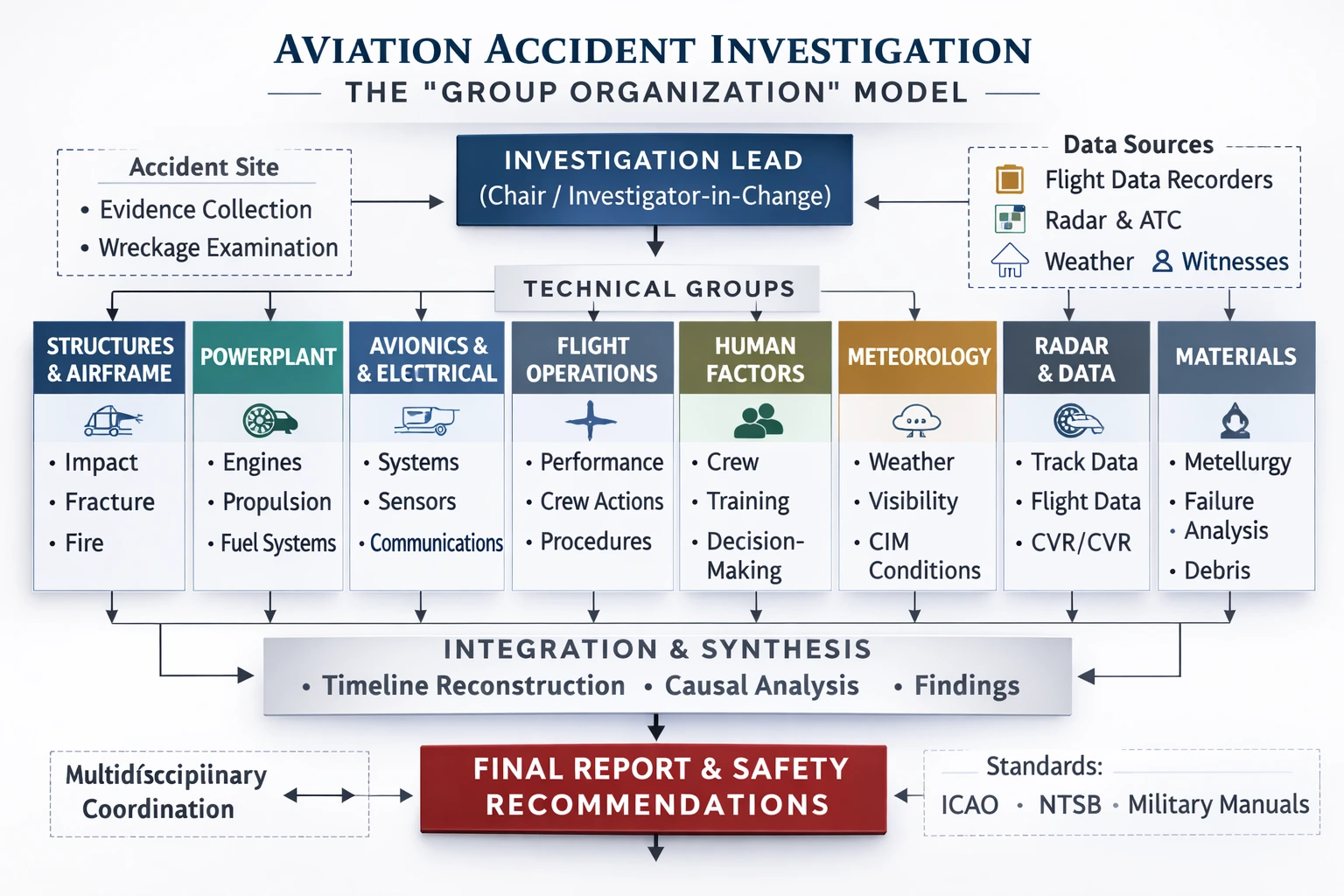
Modern aviation accident investigation follows a structured, multidisciplinary framework. Major civil and military investigative authorities organize complex aircraft investigations using a “group organization” model, in which technical specialists are assigned to defined areas of analysis and their findings are integrated into a coordinated reconstruction.
This model reflects established investigative methodology described in published guidance issued by authorities such as the International Civil Aviation Organization (ICAO) and the National Transportation Safety Board (NTSB). Comparable structured approaches are also reflected in military investigative manuals. Aviation accident reconstruction is governed by disciplined methodology rather than informal speculation.
Published Investigative Frameworks
ICAO’s Manual of Aircraft Accident and Incident Investigation and the NTSB’s Major Investigations Manual describe a systematic approach to accident evaluation. These frameworks organize investigation into defined analytical groups, each responsible for specific categories of technical evidence.
Although procedural details vary among agencies, the core structure remains consistent: accident reconstruction proceeds through coordinated technical disciplines operating within a unified investigative framework.
Multidisciplinary Technical Groups
In a major aircraft investigation, distinct technical groups may be assigned to areas such as:
- Structures and airframe evaluation
- Powerplant and propulsion systems
- Avionics and electrical systems
- Flight data and radar analysis
- Operations and flight performance
- Meteorology
- Human factors
- Materials and metallurgical examination
Each group examines physical evidence, documentation, recorded data, and operational history within its specialty. Findings are documented and later synthesized into a comprehensive sequence-of-events analysis.
Scene Evaluation and Physical Evidence
Investigation typically begins with examination of the accident site. Wreckage distribution, structural deformation, impact signatures, and system condition provide initial insight into aircraft attitude, energy state, and system performance at impact.
Physical components may undergo detailed laboratory evaluation. Metallurgical analysis, fracture surface examination, and materials testing can assist in distinguishing between pre-impact failure and impact-related damage. Engine and propulsion systems may be disassembled to evaluate internal component condition and evidence of rotational energy.
The investigative objective is not to isolate a single data point, but to assess how multiple technical indicators align within a coherent reconstruction.
Data Integration and Reconstruction
Many aircraft are equipped with digital recording systems. Flight data recorder information, cockpit voice recordings (where applicable), radar data, and other electronic sources may be integrated to evaluate aircraft performance and pilot inputs.
Interpretation of recorded data requires familiarity with system architecture, parameter limitations, and data resolution constraints. Reconstruction often involves correlation between recorded data and physical evidence observed at the scene.
The group organization model emphasizes disciplined synthesis: no single technical discipline independently determines causation. Rather, causation analysis emerges from integration of structural, mechanical, operational, and environmental findings.
Relationship to Civil Litigation
In civil aviation litigation, technical findings developed during investigation may be evaluated under evidentiary standards governing expert testimony. Courts assess whether reconstruction opinions are supported by sufficient data and reliable methodology.
Understanding the investigative structure underlying an aviation accident is therefore essential not only for safety analysis, but also for the structured presentation of technical evidence in judicial proceedings.
For an overview of how aviation accident cases proceed within the civil litigation system, see the firm’s Aviation Accident Litigation page.
This information will only be used in connection with your inquiry and will not be stored by Katzman Lampert & Stoll, or disseminated in any way.
The use of the Internet or this form for communication with the firm or any individual member of the firm does not establish an attorney-client relationship. Confidential or time-sensitive information should not be sent through this form.
Our practice exclusively involves injury and death cases resulting from airplane accidents, helicopter crashes, and aviation disasters.
MICHIGAN OFFICE
Katzman Lampert & Stoll
950 West University Dr #101
Rochester, MI 48307
E-mail: DKatzman@klm-law.com
OR Click to use our Contact Form
Toll-Free: (866) 309-6097
Phone: (248) 258-4800
Fax: (248) 258-2825
COLORADO OFFICE
Katzman Lampert & Stoll
9596 Metro Airport Ave.
Broomfield, CO 80021
E-mail: BLampert@klm-law.com
OR Click to use our Contact Form
Toll-Free: (866) 309-6097
Phone: (303) 465-3663
Fax: (303) 867-1565
PENNSYLVANIA OFFICE
Katzman Lampert & Stoll
121 N. Wayne Ave. # 205
Wayne, PA 19087
E-mail: BStoll@klm-law.com
OR Click to use our Contact Form
Toll-Free: (866) 309-6097
Phone: (610) 686-9686
Fax: (610) 686-9687