
American Airlines Flight 5342 Midair Collision Near DCA (N709PS)
Updated: Mar 31, 2026
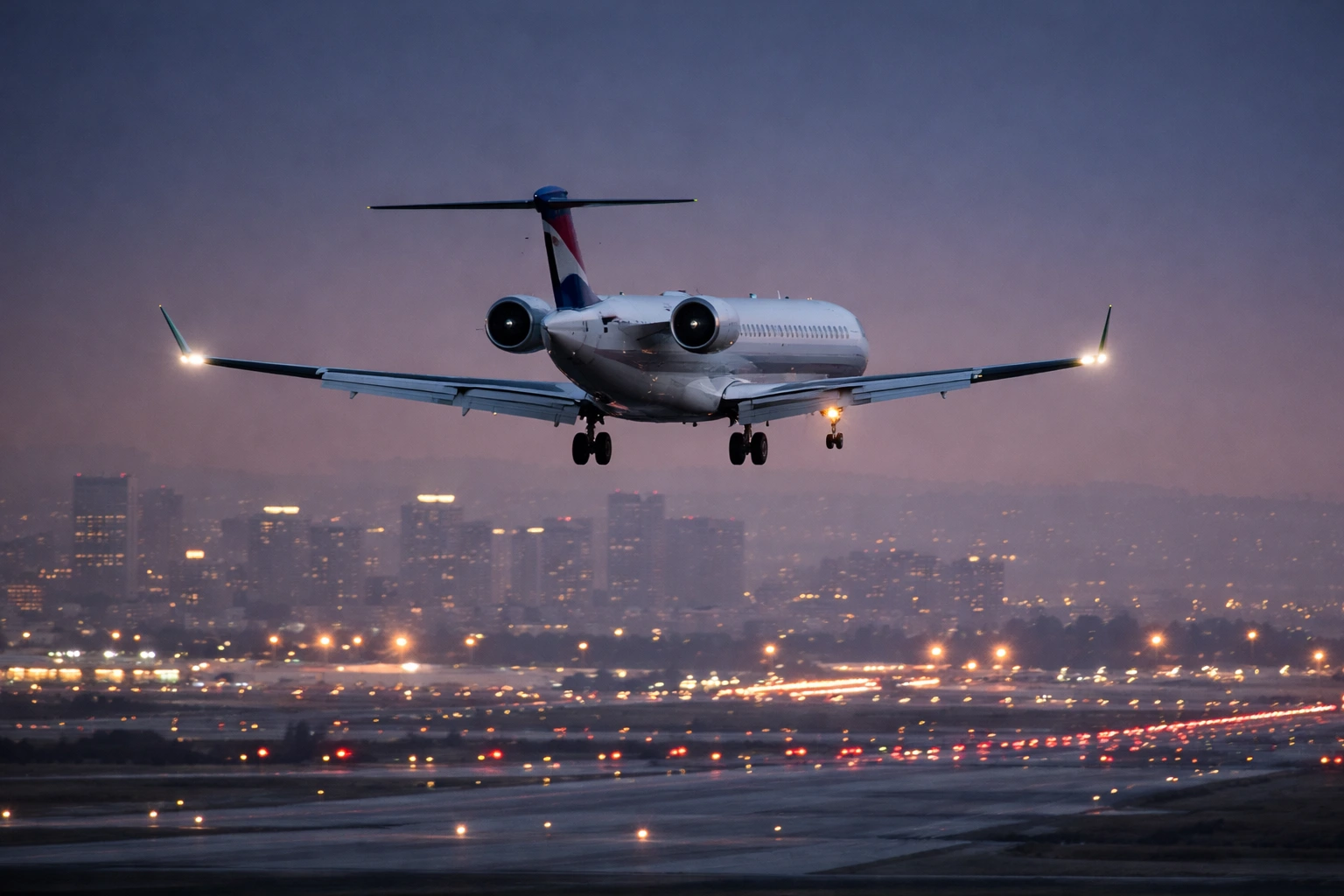
On January 29, 2025, PSA Airlines Flight 5342 operating as American Airlines Flight 5342, a Mitsubishi Heavy Industries RJ Aviation (formerly Bombardier) CL-600-2C10 (CRJ700) registered as N709PS, collided in flight with a U.S. Army Sikorsky UH-60L helicopter, tail number 00-26860, operating under the callsign PAT25 near Ronald Reagan Washington National Airport (DCA). Both aircraft impacted the Potomac River in southwest Washington, D.C., and all 67 occupants aboard the airplane and helicopter were fatally injured. The National Transportation Safety Board later concluded that the collision resulted from systemic failures involving airspace design, inadequate FAA review and mitigation of known risks, and an air traffic system that relied too heavily on visual separation in a complex terminal environment.
Accident Summary
| Date | January 29, 2025 |
|---|---|
| Location | Potomac River near Ronald Reagan Washington National Airport (DCA), Washington, District of Columbia, USA |
| Aircraft | MHI RJ Aviation CL-600-2C10 (CRJ700) (N709PS) and Sikorsky UH-60L (PAT25; tail number 00-26860) |
| Operation | Part 121 scheduled passenger flight (ICT to DCA) and U.S. Army helicopter flight (DAA to DAA) |
| Occupants | 67 total (64 on airplane; 3 on helicopter) |
| Fatalities | 67 |
| Phase of Flight | Approach (airplane) / helicopter route transit near DCA |
| Investigation | NTSB (with FAA and U.S. Army participating) |
What Happened
The CRJ700 was operating as a scheduled domestic passenger flight from Wichita Dwight D. Eisenhower National Airport to DCA under Part 121. The U.S. Army helicopter had departed Davison Army Airfield and was conducting an annual standardization evaluation using night vision goggles. Night visual meteorological conditions prevailed in the DCA area at the time of the collision.
The airplane was initially cleared for the Mount Vernon Visual Runway 1 approach and was later instructed to change to Runway 33, after which it was cleared to land on Runway 33. The helicopter requested and was approved to proceed along the local helicopter route structure toward Davison Army Airfield. As the two aircraft converged southeast of the airport, they collided in flight and fell into the Potomac River.
The NTSB’s final report concluded that the collision did not arise from a single isolated mistake. Instead, the Board found that the accident occurred within a system that placed helicopter traffic in close proximity to airline arrival paths, depended too heavily on visual separation, and did not adequately account for the limitations of see-and-avoid in dense nighttime terminal operations.
Aircraft and Operational Context
The airplane involved was a CRJ700 (CL-600-2C10) registered as N709PS and operated by PSA Airlines as Flight 5342 under the American Airlines brand. The helicopter was a Sikorsky UH-60L operated by the U.S. Army under the callsign PAT25. The fatalities included 2 pilots, 2 flight attendants, and 60 passengers on the airplane, along with 3 crewmembers aboard the helicopter.
The final report discussed the operational environment around DCA in substantial detail. Helicopter routes in the area were designed to facilitate movement through constrained and high-density airspace, but the route structure and applicable altitude limitations placed rotary-wing traffic in close proximity to fixed-wing arrival operations. The NTSB also noted that the route system relied on charted paths associated with geographic features rather than defined protected corridors, increasing the importance of communications, altitude compliance, situational awareness, and effective traffic separation.
Accident Investigation
The NTSB investigated the collision through multiple groups addressing operations, air traffic control, performance, flight recorders, structures, systems, survival factors, and related subjects. Investigators analyzed cockpit voice recorder and flight data recorder information from both aircraft, radar and ADS-B data, air traffic control recordings, route structure, charting, and the broader DCA operating environment.
The completed investigation found that the accident resulted from systemic shortcomings rather than a narrow sequence of last-second events alone. The NTSB found that the FAA had placed a helicopter route too close to an active runway approach path, had not regularly reviewed and evaluated helicopter routes and available safety data adequately, and had failed to act on prior recommendations and other warning information that could have reduced the risk of a midair collision near DCA. The Board also found that air traffic control practices contributed to the accident because elevated controller workload reduced the ability to monitor developing conflicts and issue timely safety alerts.
The investigative process in major aviation matters is discussed in greater detail in our overview of the NTSB investigation process.
Operational and Regulatory Issues
Midair collision investigations commonly examine how traffic separation is maintained where mixed operations occur in tightly constrained airspace. In this accident, the NTSB’s final report focused on the interaction between the DCA arrival environment, helicopter route placement, visual-separation practices, controller workload, and the communication structure used for airplane and helicopter traffic.
The Board concluded that the system relied too heavily on visual separation to maintain efficiency without sufficient regard for the practical limits of see-and-avoid in this operating environment. It also found that separate radio frequencies for helicopters and airplanes increased risk because not all critical transmissions were fully heard by both crews. These findings place the accident within a broader regulatory and operational context involving airspace design, FAA oversight, route review, and the management of mixed fixed-wing and rotary-wing traffic near major commercial airports.
Because the helicopter flight was a night-vision-goggle standardization evaluation, the operating context also included training-related workload and visual-acquisition demands during nighttime helicopter operations in dense terminal airspace. The NTSB’s final report makes clear, however, that the accident analysis extends beyond cockpit workload alone and includes the structural safety consequences of route design and longstanding oversight failures.
Aviation Accident Litigation
Separate from the NTSB’s safety mission, civil litigation following a fatal midair collision can involve extensive evidence preservation, technical reconstruction, and analysis of operational design decisions. The legal evaluation may address how route structures, communications protocols, separation practices, oversight responsibilities, and safety recommendations were implemented or not implemented before the collision. Any such assessment should remain grounded in verified investigative findings and preserved technical evidence.
In complex aviation matters involving multiple aircraft, government entities, and high-density airspace procedures, case development typically requires specialized aviation expertise and careful reconstruction of the factual record, including issues that may arise in military and government-contractor aviation litigation. That work can include analysis of route design, training and qualification records, controller practices, published procedures, and the communications sequence established through the investigation.
Where civil claims are pursued after an event of this kind, the loss-of-life issues can also implicate wrongful death claims after an aviation accident.
Consultation Regarding Aviation Accident Investigations
Families, referring attorneys, and journalists sometimes seek legal consultation or technical insight regarding aviation accidents and investigative issues discussed in these analyses. Inquiries may be directed to Katzman, Lampert & Stoll at the link below.
Aviation Accident Litigation
- Aviation Accident Litigation
- Private and Corporate Aircraft Accident Litigation
- Military & Government Contractor Aviation Litigation
- Complex Aviation Litigation Methodology
- NTSB Investigations & Civil Aviation Claims
- Federal Preemption in Aviation Product Liability
- Defeating GARA Defenses in Aviation Product Liability Litigation
- For Families and Survivors
MICHIGAN OFFICE
Katzman Lampert & Stoll
950 West University Dr #101
Rochester, MI 48307
E-mail: Click to use our Contact Form
Toll-Free: (866) 309-6097
Phone: (248) 258-4800
Fax: (248) 258-2825
COLORADO OFFICE
Katzman Lampert & Stoll
9596 Metro Airport Ave.
Broomfield, CO 80021
E-mail: Click to use our Contact Form
Toll-Free: (866) 309-6097
Phone: (303) 465-3663
Fax: (303) 867-1565
PENNSYLVANIA OFFICE
Katzman Lampert & Stoll
121 N. Wayne Ave. # 205
Wayne, PA 19087
E-mail: Click to use our Contact Form
Toll-Free: (866) 309-6097
Phone: (610) 686-9686
Fax: (610) 686-9687