
Eurocopter EC130 Tourist Helicopter Crash at Grand Canyon West Rim
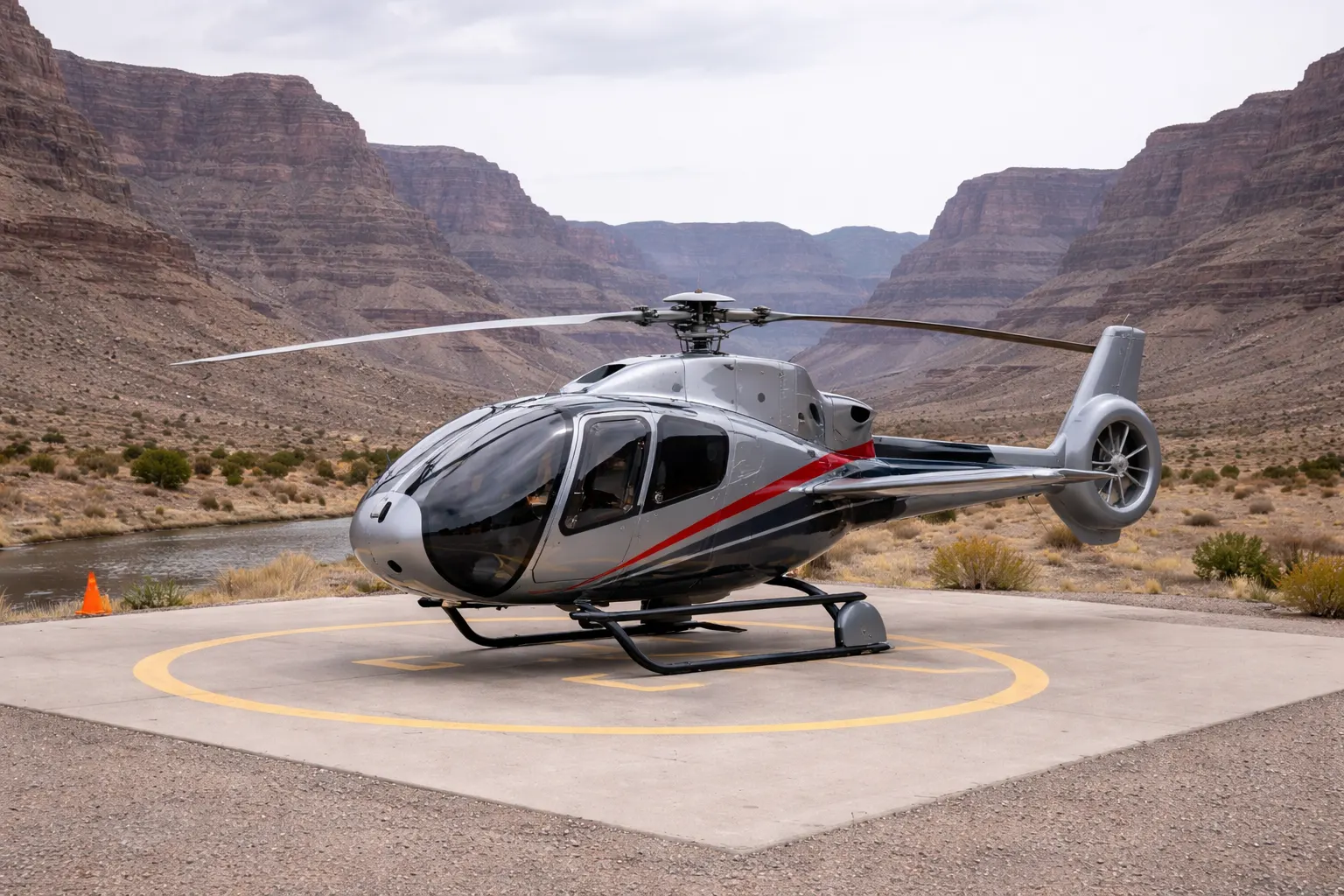
On February 10, 2018, a Eurocopter EC130 operated by Papillon Grand Canyon Helicopters crashed in Quartermaster Canyon near the Grand Canyon’s West Rim. The accident was followed by a post-crash fire, and three passengers were fatally injured, with four others—including the pilot—reported seriously injured and transported for medical care. Federal investigators examined the crash sequence, operational circumstances, and the post-impact fire environment to determine the factors that contributed to the accident.
Accident Summary
| Date | February 10, 2018 |
|---|---|
| Location | Quartermaster Canyon, Grand Canyon West Rim, Arizona, United States |
| Aircraft | Eurocopter EC130 (Airbus Helicopters EC130) |
| Operation | Tourist sightseeing flight (Papillon Grand Canyon Helicopters) |
| Occupants | 7 total (not publicly reported: passengers/crew split) |
| Fatalities | 3 |
| Phase of Flight | Not publicly reported |
| Investigation | National Transportation Safety Board (NTSB) |
What Was Reported at the Scene
Early reporting described the helicopter crashing in a remote, rugged area near the West Rim and then burning, with flames and black smoke photographed by witnesses. Access to the site was described as difficult due to terrain, which can affect the speed and logistics of emergency response and wreckage recovery.
Reporting indicated that the passengers on board were tourists from the United Kingdom. The pilot and three other survivors were described as seriously injured and airlifted to a hospital in Las Vegas.
Aircraft and Operational Context
The EC130 is a single-engine helicopter frequently used for sightseeing and tour operations because of its passenger capacity and visibility characteristics. Tour flight operations in canyon environments can involve changing wind conditions, localized turbulence, and terrain-driven operational constraints that differ from routine point-to-point helicopter transport.
Investigators in tourism-related helicopter accidents typically consider operational planning, route selection, altitude and terrain clearance, weight and balance, and whether weather conditions and local wind effects may have influenced controllability or performance at the time of the accident.
Accident Investigation
The National Transportation Safety Board opened an investigation into the crash. NTSB investigations generally involve on-scene documentation, wreckage examination, review of maintenance and operational records, and evaluation of environmental conditions. A broader overview of how federal investigations proceed is provided in our discussion of the NTSB investigation process.
In a helicopter crash followed by fire, investigators commonly evaluate the rotor system and drivetrain, flight control continuity, engine and fuel system condition, and any evidence of pre-impact anomalies. Investigators may also review operational procedures, pilot training and experience, and whether the tour operator’s policies and risk management practices were appropriate for the operating environment.
Post-crash fire can affect the availability of physical evidence and may require investigators to rely more heavily on recovered components, recorded data if available, and external sources such as witness observations and communications logs. Investigators may also examine fuel system integrity and potential ignition sources as part of the fire sequence analysis.
Operational and Regulatory Issues
Tour helicopter operations often occur under established local practices and operating limitations, and the investigation may examine how the operator planned and managed flights in a terrain-constrained environment. Where weather or winds are relevant, investigators may correlate meteorological data with the flight’s timeline and the known wind patterns in canyon areas.
Operational oversight issues can include dispatch decision-making, adherence to operating limitations, and how crews are trained to recognize and mitigate hazards such as localized turbulence, downdrafts, and reduced performance margins. At the early stage, these questions are addressed through evidence development rather than assumptions about causation.
Aviation Accident Litigation
Fatal helicopter tour accidents can involve complex questions concerning aircraft performance, maintenance practices, operational decision-making, training, and oversight. A general overview of how these matters are evaluated is provided in our discussion of aviation accident litigation.
Examples of aviation matters involving technical causation and operational oversight issues are summarized on our Representative Aviation Matters page.
For context regarding reported outcomes in aviation-related disputes, see Selected Aviation Verdicts & Settlements.
Broader observations regarding recurring issues in reported aviation accident litigation are discussed in Aviation Crash Litigation: Common Patterns in Reported Cases.
Contact Katzman Lampert & Stoll
Katzman Lampert & Stoll welcomes inquiries from individuals, families, and referring attorneys regarding aviation accident matters nationwide. The firm has represented clients in aviation cases arising throughout the United States, including matters involving commercial airline accidents, private and corporate aircraft, helicopter operations, and aircraft product liability litigation.
If you have questions following an aircraft accident or would like to discuss a potential aviation case, the firm can provide an initial assessment of the circumstances and explain the legal and investigative process involved.
The firm represents clients on a contingency fee basis. Legal fees are paid only if a recovery is obtained on behalf of the client.
You may contact the firm by telephone at 248‑258‑4800, or, if you prefer, you may send a message through the secure contact form on this page.
This information will only be used in connection with your inquiry and will not be stored by Katzman Lampert & Stoll, or disseminated in any way.
The use of the Internet or this form for communication with the firm or any individual member of the firm does not establish an attorney-client relationship. Confidential or time-sensitive information should not be sent through this form.
- Aviation Accident Litigation
- Private and Corporate Aircraft Accident Litigation
- Military & Government Contractor Aviation Litigation
- Complex Aviation Litigation Methodology
- NTSB Investigations & Civil Aviation Claims
- Federal Preemption in Aviation Product Liability
- Defeating GARA Defenses in Aviation Product Liability Litigation
- For Families
MICHIGAN OFFICE
Katzman Lampert & Stoll
950 West University Dr #101
Rochester, MI 48307
E-mail: Click to use our Contact Form
Toll-Free: (866) 309-6097
Phone: (248) 258-4800
Fax: (248) 258-2825
COLORADO OFFICE
Katzman Lampert & Stoll
9596 Metro Airport Ave.
Broomfield, CO 80021
E-mail: Click to use our Contact Form
Toll-Free: (866) 309-6097
Phone: (303) 465-3663
Fax: (303) 867-1565
PENNSYLVANIA OFFICE
Katzman Lampert & Stoll
121 N. Wayne Ave. # 205
Wayne, PA 19087
E-mail: Click to use our Contact Form
Toll-Free: (866) 309-6097
Phone: (610) 686-9686
Fax: (610) 686-9687